

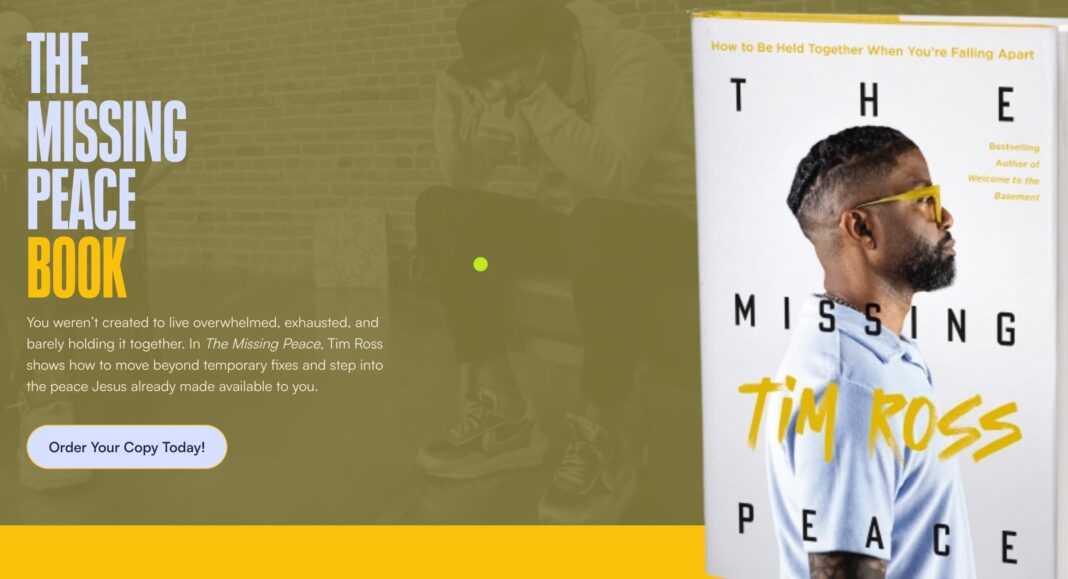

 Tim Ross is the host of the popular podcast The Basement and author of The Missing Peace, released today, May 5, 2026.
Tim Ross shows Team Jesus how to move beyond temporary fixes and step into the peace Jesus already made available to you. Check out our interview with Tim Ross below.
Team Jesus Magazine: Your book is called The Missing Peace. In a world that seems more chaotic than ever, how do you define the kind of “peace” you’re talking about? Is it different from simply being happy or calm?
Tim Ross: The peace I’m talking about isn’t based on what’s happening around you. It’s something internal. It’s anchored. It’s something you carry. Most people think peace means everything is going right. No stress, no pressure, no problems. But real peace is what regulates you when everything is going wrong. Happiness is emotional and comes and goes. Calm can be situational. But this kind of peace is rooted in God and shows up in your body. It steadies you. There’s a difference between looking peaceful and actually being at peace. You can smile and still be falling apart inside. The kind of peace I’m talking about stabilizes you from the inside out so your circumstances don’t get to define you.
Team Jesus Magazine: A major theme is learning to create safety within your body, mind, and environment. What is one practical first step someone can take today to make their body a safer place?
Tim Ross: The first step is slowing down long enough to actually notice what’s going on inside your body without trying to fix it right away. Most people are disconnected. We either numb out or push through. But your body is always telling the truth, even when your mind is just trying to survive. So start simple. Pause. Take a slow breath. Ask yourself, what am I feeling in my body right now? Not what you think. What you feel. Tight chest, shallow breathing, tension in your shoulders. Those aren’t problems; those are signals. When you can sit with what you’re feeling without judging it, you start teaching your body that it’s safe to feel. That’s where healing begins.
Team Jesus Magazine: You distinguish between “vertical healing” (with God) and “horizontal healing” (with people). Why are both necessary for true wholeness?
Tim Ross: Vertical healing is your relationship with God. That’s where your identity gets rooted. That’s where you learn your worth and your belonging. But horizontal healing is what happens in relationships with people. That’s where everything gets tested. You can feel completely loved by God when you’re by yourself but still get triggered, defensive, or shut down when you’re around others. That’s the gap a lot of people live in. Spiritually secure but relationally struggling. God may reveal what needs healing, but people are usually where it shows up. And that’s part of the process. Real wholeness happens when what God does in you actually changes how you show up with others. You need both.
Team Jesus Magazine: One of the most powerful lines in your book is, “Vulnerability is a superpower.” For someone who views vulnerability as a weakness or a risk, can you explain why it is so powerful?
Tim Ross: Vulnerability feels like a risk because for a lot of us it was a risk. At some point being open got us hurt, rejected, or misunderstood. So we learned to protect ourselves and called that strength. But a lot of what we call strength is really just isolation dressed up nice. Vulnerability is powerful because it’s the only way you actually heal and connect. You can’t heal what you hide. You can’t be fully loved if people only see part of you. Now it has to be done wisely. This isn’t about telling everything to everybody. It’s about telling the truth in safe spaces. And when you’re fully seen and not rejected, something shifts inside of you. That’s real power.
Team Jesus Magazine: The book addresses breaking generational cycles of trauma, addiction, and abuse. What kind of legacy do you hope to create, and how can readers begin building new, healthier legacies for their families?
Tim Ross: I’m not just trying to change my life. I’m trying to stop patterns that were handed to me so they don’t get passed down. Legacy isn’t just what you leave behind. It’s what stops with you. The anger, the silence, the addiction, the emotional distance. That cycle can end if somebody decides to do the work. For me, the legacy is emotional safety, spiritual depth, and honesty in relationships. I want my ceiling to be my kids’ floor. For readers, it starts with awareness. You have to name what was unhealthy without pretending it didn’t affect you. Then you do the work. Get support. Make different choices even when it feels uncomfortable. You don’t have to be perfect. You just have to be intentional. That’s how things change.
Team Jesus Magazine: If a reader takes away only one message from The Missing Peace, what do you hope it is?
 Tim Ross: That healing isn’t something you have to perform. It’s something you’re allowed to experience. You’re not too broken. You’re not too far gone. You’re not too late. The peace you’re looking for isn’t somewhere out there. It’s something God wants to build inside of you. And it doesn’t come from avoiding your story. It comes from facing it with the right support and the right truth. You don’t have to keep surviving your life. You can actually feel safe in it.
If you’re searching for peace that goes beyond your feelings and transforms your soul, grab your copy of The Missing Peace today.